
Key takeaways
- A jack-up barge gives a more stable deck for SPT, sampling, core recovery, CPT and depth control, but it costs more, is scarcer and needs enough water to float.
- A floating pontoon on a 4-point mooring is cheaper and reaches very shallow water, but heave and roll can complicate depth control and the repeatability of SPT measurements; tides, weather and mooring behavior also have to be managed.
- Choose on availability, sea state, tide, seabed, data specification and borehole count, and compare cost per usable borehole, not day rate.
Why jack-up barge vs pontoon is a real choice in nearshore geotechnical investigation
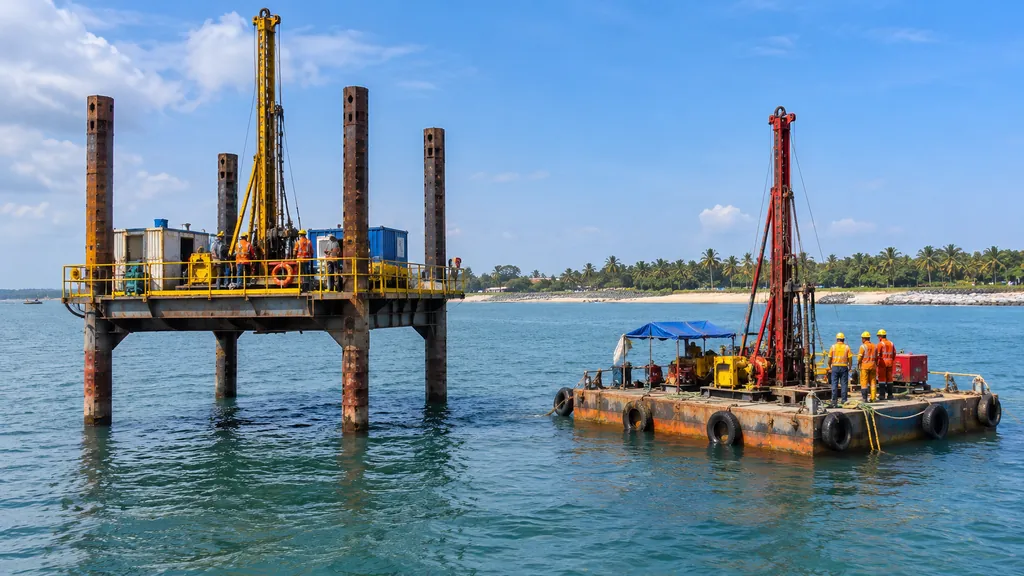
For nearshore geotechnical investigation, the choice between a jack-up barge and a floating pontoon held by a 4-point mooring is rarely a purely technical decision. Three practical constraints usually shape the choice:
- Short supply: Very few jack-up barges are available for geotechnical drilling, so availability alone often decides.
- Cost variation: Depending on the unit, mobilization, site conditions and scope, the total cost of a jack-up and pontoon spread can differ by as much as an order of magnitude in some campaigns. On general geotechnical investigation campaigns, we have seen jack-up mobilization and demobilization account for around 30% of the investigation cost. These are project-specific observations, not standard rates; compare actual quotations and assess the implications for programme and data quality.
- Draft limits in very shallow water: A jack-up needs enough depth to float, manoeuvre and jack up (in our experience, about 2.0 m of water at minimum), so it cannot reach shallow flats and intertidal zones that a shallow-draft pontoon can.
A pontoon is therefore often selected, but its implications for data quality, programme and total cost need to be assessed at tender stage. This article compares both platforms in relation to sample quality, core recovery, tidal handling, in-situ testing and mobilization, and sets out a practical basis for selection.
Why nearshore geotechnical investigation is tricky
The main concern is relative movement between the drilling system and seabed. Heave, roll or pitch may affect borehole stability, SPT execution, sampling and core recovery, depending on how the casing, rods and rig are supported.
Nearshore sites make that hard to avoid:
- Waves and swell: Short-period chop and monsoon swell can stop a floating rig even when the wind is light.
- Tide and currents: Tidal variation changes the water depth and working geometry during a tidal shift, and currents load anchors, mooring wires and the drilling arrangement. Current speed should not be inferred from tidal range alone.
- Shallow-water access: Check the pontoon’s loaded draft and required under-keel clearance, as well as the water depth and anchor geometry needed to hold station. A jack-up generally needs about 2.0 m of water to float and jack up in our experience, before its legs are deployed and the hull is elevated. Confirm the limits for the actual unit and spread.
- Variable seabed: Soft clay, loose sand, stiff crusts, boulders and rock can all appear within one site, and each change how anchors or legs behave.
- Data requirements: Identify the required SPT, undisturbed sampling, rock coring and other in-situ tests. For Indian projects, refer to IS 1892:2021 for subsurface investigation and IS 2131:2025 for the Standard Penetration Test. For marine soil investigation, ISO 19901-8:2023 provides relevant guidance. Confirm the governing standards and editions in the project specification.
Option 1: The jack-up barge
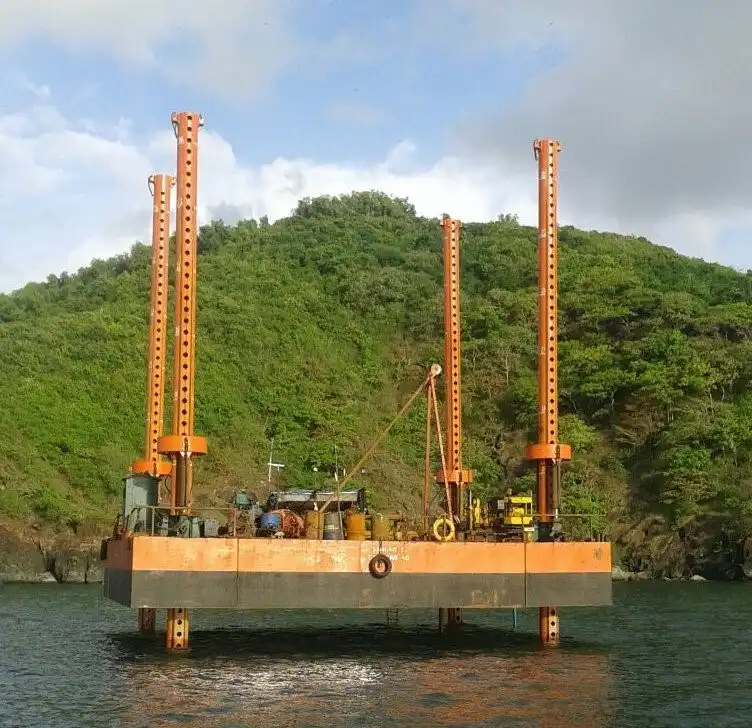
Once its legs are set and the hull elevated, a jack-up provides a substantially more stable working platform. It is motion-free; but leg response, structural flexibility and environmental loading still matter. Small three- or four-leg units are common nearshore.
Strengths
- More stable deck: Reduced heave, roll and drift help maintain consistent drilling conditions and repeatable SPT and sampling procedures.
- Wider weather window: than a floating pontoon, within the unit’s design limits, air gap and site conditions.
- Fixed position: No anchor wires cross the site, and tidal variation is handled through the air gap; check the full tidal range and working configuration.
- Reaction and depth control: Provides a stable reaction system for conventional CPT, subject to equipment capacity, and a relatively stable reference for depths, provided the datum and tide records are kept.
Limits
- Leg penetration and punch-through: Legs may sink deeply into soft clay or punch through a stronger crust over weaker material.
- Leg extraction: legs can stick in soft clay and may need jetting to pull free.
- Mobilization and demobilization cost: This can be substantial, particularly for a small number of boreholes. The amount varies with the unit, distance, port arrangements and borehole count, so verify it through project-specific costing.
- Availability and total cost: Few units are configured for geotechnical work, and a jack-up will generally cost more than a pontoon spread. Compare like-for-like quotations, including programme, downtime and data-quality risks.
- Draft and water-depth window: The unit needs enough water to float, manoeuvre and jack up, so very shallow water and intertidal areas may be inaccessible. Leg length, penetration and air gap also govern suitability.
Option 2: Floating pontoon with a 4-point mooring
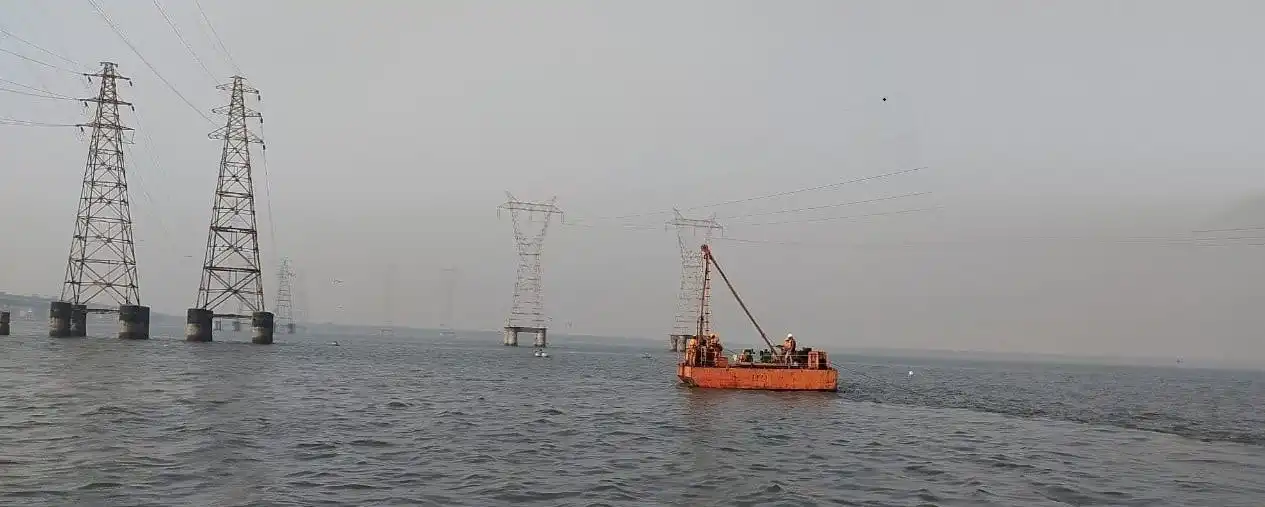
A floating pontoon is often more economical in sheltered conditions and can access water too shallow for a jack-up. Four anchors hold it on station, with winches used to adjust the wires and reposition the barge. The layout and holding capacity must suit water depth, seabed, current, waves and marine traffic.
Strengths
- Generally lower mobilization and demobilization cost and a shallow draft make it economical for small campaigns and very shallow water.
- Widely available locally.
Limits
- Motion and sample disturbance: A floating platform heaves, rolls and pitches, and the effect depends on the platform, sea state, casing support and any heave-control system. In our field experience, TCR in weathered zones has differed by about 20-30% between floating and more stable platforms on some projects. Treat this as indicative, since recovery also depends on the formation, drilling method, core barrel and operator practice.
- Tidal handling: A changing water level may require adjustments to rods, casing or the drilling arrangement. In our experience, where tidal variation exceeds about 1.0 m, noticeable time can be lost adding and removing rods and casing as the tide rises and falls. The contractor should show how the setup handles the full tidal range.
- CPT and reaction: Conventional CPT needs adequate reaction and restraint, which a floating pontoon may not provide reliably..
- SPT execution and energy transfer: Heave and roll can move the hammer, rods and borehole reference during blows. The effect depends on casing and rod support and hammer guidance; with casing seated in the seabed and a properly guided hammer, a pontoon can produce acceptable SPT results. Where support is inadequate, N-value repeatability and assessment of energy delivery may be affected. Do not infer the energy ratio from platform type; where correction is required, measure it instrumentally on the actual hammer and rod setup.
- Depth control and borehole reference: Heave moves the rig floor and drilling reference vertically relative to the seabed. If depths are measured from the moving platform, the reference changes with platform movement and water level. In the usual floating-pontoon drilling arrangement, reliable borehole depth control is not achievable.
- Weather downtime: Swell can interrupt drilling. For a typical pontoon spread, a significant wave height of up to 5 m is workable.
- Anchor holding and positioning: Anchor performance depends on anchor type, seabed, embedment, loading and scope, and rock, boulders or thin sediment over rock make drag anchors difficult. The barge also moves within its watch circle, and wires and buoys cover a wide area, so agree positioning tolerances and navigation arrangements before work starts.
Side by side
A jack-up generally offers greater stability and reaction capacity; a 4-point moored pontoon usually offers lower mobilization cost and access to shallower locations. Actual performance depends on the unit, equipment, site and work method.
Factor | Jack-up barge | Floating pontoon with 4-point mooring |
Platform stability | More stable once elevated; structural and environmental limits remain. | Subject to heave, roll and pitch; performance depends on the mooring and drilling arrangement. |
Water depth and draft | Needs sufficient water to float and manoeuvre; leg length, penetration and air gap govern suitability. | Shallow draft; access depends on pontoon draft, under-keel clearance and anchor layout. |
Wave operating limit | Governed by unit design, air gap and site-specific limits. | Spread-specific; confirm documented limits for the pontoon, mooring and drilling arrangement. |
SPT and sampling | Generally provides more stable working conditions. | Acceptable results are achievable with suitable casing support and a guided hammer. |
Core recovery | Reduced platform movement may improve consistency; formation and drilling method remain important. | More sensitive to platform motion and drilling setup; assess recovery against the ground and method. |
Tidal variation | Air gap and drilling arrangement must accommodate the predicted water levels. | Requires adjustment for changing water level; refer to the tidal-variation discussion. |
CPT and reaction-based tests | Can provide reaction for conventional CPT, subject to equipment capacity. | Reaction required for conventional CPT is not available. |
Borehole depth control | Relatively stable reference; datum and tide records are still required. | Not achievable with the usual floating-pontoon drilling arrangement. |
Mobilization and demobilization Cost | Generally substantial, particularly for small campaigns; assess project-specific quotations. | Often lower; depends on unit, distance, anchor handling and site logistics. |
Total cost | Usually higher; compare actual quotations and programme risks. | Often lower in suitable sheltered conditions; include downtime and data-quality risks. |
Weather downtime | May offer a wider working window, within the unit’s rated limits. | More sensitive to swell and waves; confirm the contractor’s operating limits. |
Typical application | Where stability, reaction capacity or a wider operating window is required. | Sheltered, shallow-water sites and smaller campaigns, subject to seabed and mooring conditions. |
Tidal variation and the 4-point mooring
Tidal range matters, but it does not by itself decide whether a 4-point mooring is feasible. Water depth, current velocity, wave climate, anchor holding and the drilling arrangement matter too.
Field rule of thumb. In our experience, a 4-point mooring has been workable within approximately 2 m of tidal variation. Above approximately 1 m, additional time may be lost adjusting rods and casing as the tide rises and falls. Beyond approximately 2 m, a jack-up is usually the safer choice. These are practical field observations and screening guidance, not universal design limits; the actual choice must also consider water depth, current velocity, wave climate, anchor holding, mooring geometry and the drilling arrangement.
How to choose
Start with available equipment and site conditions; either may rule out an option. Then assess:
- Wave climate: Establish the expected significant wave height, period and direction for the working season. A floating pontoon may suit sheltered conditions, but its limit must come from the contractor’s actual spread and method statement. A jack-up may offer a wider window only within its rated limits; verify leg-length and air-gap margins at the highest predicted water level and for the design wave conditions.
- Water depth and draft: A shallow-draft pontoon may access intertidal areas, subject to anchor geometry and holding. A jack-up needs adequate water to float and manoeuvre; check the actual unit’s leg length and operating rating.
- Tidal conditions: Assess the full tidal range together with current velocity, water depth and mooring geometry. Use the field observations in the tidal-variation section as screening guidance, not as a substitute for a site-specific mooring assessment.
- Seabed: Soft, uniform sediment may suit either system. Rock, boulders or thin sediment over rock challenge drag anchors; a jack-up also needs a leg-penetration and punch-through assessment where stiff material overlies weaker soil. Geophysical data can help locate rock head and boulders.
- Number of boreholes and mobilization: compare actual mobilization and demobilization quotations. Jack-up mobilization can be disproportionate for a short campaign, while a longer programme spreads the cost over more boreholes. Confirm the effect through project-specific costing rather than applying a standard percentage.
- Season: Account for monsoon, cyclone and swell conditions, with realistic weather downtime.
- Total cost and availability: Compare cost per usable borehole, including mobilization, downtime, standby, anchor handling, data quality and remedial work. Confirm jack-up availability early.
If uncertain, request method statements and comparable prices for both options, including environmental limits, downtime assumptions and deliverables.
Practical tips from the field
Most data problems arise from setup rather than rig type. Before mobilization, confirm port and marine-authority permissions, vessel certification, safety arrangements and personnel-transfer procedures.
Running a 4-point mooring
- Lay out anchors symmetrically around the working location where practicable. A mooring assessment for the actual barge, depth, seabed, current and waves should set the layout, lead angles, anchor type and wire scope; a fixed 45° angle is not a universal rule. Proof-load the anchors and verify holding before drilling.
- Where practicable, seat casing in the seabed and guide it through a moon pool. A heave-compensated clamp or similar motion-control arrangement may reduce movement reaching the drill string. For SPT, use a consistent hammer release and rod arrangement, and record the hammer system and any instrument-measured energy ratio.
- Use DGPS or equivalent, establish the project vertical datum, record tide and water level, and document the reference used for borehole, SPT and sample depths.
- Mark anchor buoys with lights, notify the port authority and local fishermen, and keep a spare anchor and standby tug.
- Agree written go/no-go limits for wave height, wind and current based on the actual platform, mooring and drilling system.
Running a jack-up
- Complete a leg-penetration and punch-through assessment with the best available geotechnical information before mobilization.
- Set the air gap using the predicted highest water level, design wave crest, storm allowance and the unit’s operating criteria, and verify that adequate leg-length and air-gap margins remain.
- Assess scour around the legs and plan leg extraction, including contingencies for difficult ground.
- Sequence the boreholes to minimize the number of moves.
Conclusion
Select the platform for the required data, site conditions and working season—not day rate alone. A 4-point moored pontoon may suit sheltered, very shallow sites and small campaigns. A jack-up is often preferable where stability, reaction-dependent testing or a wider operating window is required. Support the choice with a site-specific assessment and method statement.
The practical decision comes down to three questions:
- Can the platform safely maintain the required drilling and testing arrangement in the site’s environmental conditions?
- Can the contractor demonstrate reliable depth control, sampling and core recovery for the specified investigation?
- Which option delivers the lower cost per completed, usable borehole after mobilization, downtime and data quality are considered?
Frequently asked questions
1.Can CPT be done from a floating pontoon?
Conventional CPT needs adequate reaction and restraint, which a typical pontoon may not provide. Seabed CPT or engineered reaction arrangements may be possible; confirm the method against the specification.
2. Why is a jack-up barge expensive for a small campaign?
Mobilization and demobilization can form a major share of the cost, particularly when only a few boreholes are planned. In such cases, these costs can rival or exceed the combined cost of drilling and laboratory testing.
3. Can reliable borehole depth control be achieved from a floating pontoon?
Not with the usual floating-pontoon drilling arrangement. Platform heave and changing water level affect the drilling reference relative to the seabed, making reliable borehole depth control difficult to establish.